
Sensys Gatso’s Global Perspective
Sensys Gatso’s Global Perspective
Sensys Gatso is a company that operates in the global Road Safety market. The global market for Road Safety is estimated to be around USD 4.4B annually with a CAGR of 9% (source: Road Safety Market 2023 by MarketsandMarkets). Sensys Gatso has structured itself in such a way that it benefits from being a worldwide company while still being able to meet the individual needs of customers in local markets.
Sensys Gatso’s structure
Sensys Gatso’s organizational structure has been designed to place the customer contact point as close to the customer as possible. Sensys Gatso has multiple entities worldwide, including Sensys Gatso USA, Sensys Gatso Sweden, Sensys Gatso Netherlands, Sensys Gatso Middle East, and Sensys Gatso Australia.
Each of those organizations has been assigned to serve one or more particular markets. Sensys Gatso has the option to service each of those markets directly through its own organization or indirectly through a partnership with another company. When Sensys Gatso represents, for example, a smaller portion of the overall solution or when there is a particular need for local content or labor, an indirect market method is selected.
Local market dynamics
Every market has unique needs when it comes to technology. These rules are typically a consequence of the laws pertaining to automated traffic enforcement. A good example would be whether the owner of the car or the driver is legally responsible for any possible infraction. This distinction defines how the photo of the violating vehicle needs to be taken. Sensys Gatso is organizing its global development to maximize its fit in the various markets.
The degree to which a market is decentralized or centralized is another crucial consideration. An appointed, centralized authority is in charge of procurement in a centralized market, and they are typically also in charge of running the traffic enforcement systems. Local governments, such as cities or provinces, are in charge of selecting the technologies and suppliers in a decentralized market.
In most markets, automated traffic enforcement equipment must adhere to legal requirements. Independent certification bodies will issue type approval certifications after determining that the equipment complies with the applicable legislation. This process is typically very intensive and may take a long time to complete.
Depending on the client’s procurement strategy, a multi-vendor or single vendor strategy can be implemented. For example, a multi-vendor strategy is chosen when the customer wants to spread risks related to project execution or risk of vendor continuation, whereas a single vendor strategy is typically chosen when economies of scale have been demonstrated to be significant.
Focus on growth
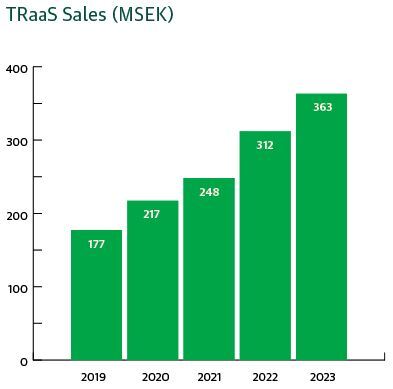
Sensys Gatso has been concentrating on recurring revenue streams as part of its strategy, referred to as TRaaS (Traffic enforcement as a Service). This is being done in order to have a more consistent and increasing revenue stream in addition to System Sales, which are heavily project-dependent and subject to volatility surges. The graph below shows how much this segment has expanded over the past few years. The ambition of the company is to have recurring revenue at MSEK 600 by 2025 with a total revenue of MSEK 1,000.
The table below shows the development of revenue over the last 5 years per region.
Net sales by region
| Net sales by region | 2023 | 2022 | 2021 | 2020 | 2019 |
| Europe | 155 | 123 | 145 | 153 | 188 |
| America | 209 | 207 | 126 | 119 | 103 |
| Middle East and APAC | 260 | 164 | 234 | 183 | 115 |
| Total | 624 | 495 | 507 | 454 | 406 |
Sensys Gatso USA
North America
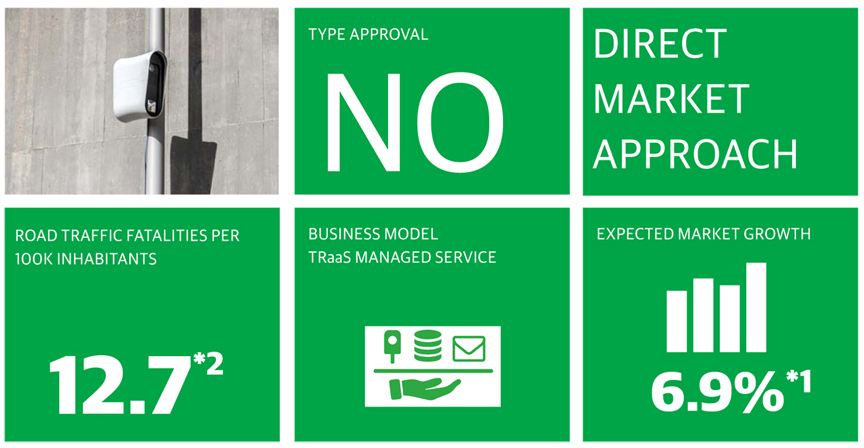
The US market is exclusively operated under the TRaaS Managed Services business model. Sensys Gatso owns and operates the equipment and manages the program on behalf of the customer. The pricing structure is either a monthly fixed fee, per issued citation, per paid citation or a hybrid of fixed fee and per citation fee.
Sensys Gatso handles the majority of the program management for our customers, including engineering, permitting, installation, operation, maintenance, violation processing, customer service, payment processing and data management. The local government approves the violations and is responsible for the adjudication of infractions that are appealed. Our offering is designed to be a full turn-key traffic safety solution.
All of Sensys Gatso’s contracts are with local municipalities, and the contract’s base term is typically between 5 and 7 years. Sensys Gatso currently has over 45 active programs in 11 states.
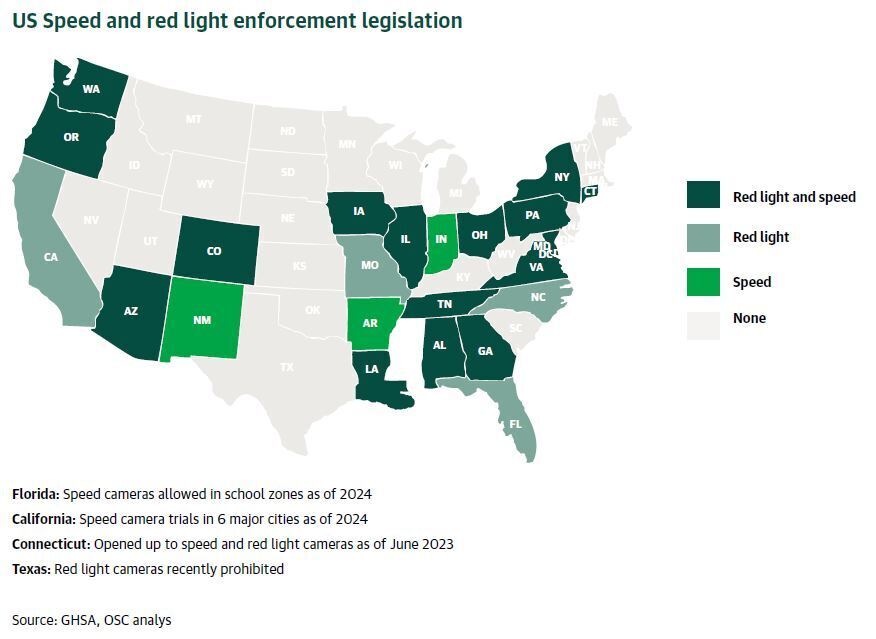
Programs are either operated under state legislative authority or by local municipal ordinance. The most common enabling legislation is for red light, speed and school bus stop arm automated enforcement. In November 2023, the US Congress passed the Infrastructure Bill, enabling investments in infrastructure and traffic. At the same time, traffic fatalities in the US are increasing, which leads to more states opening up for automated traffic enforcement programs.
As a result of that, several new markets have opened up, including Florida (school zone speed and school bus stop arm) and Connecticut (red light and safety zone speed). Each prospective municipality may require a competitive bid process, whether it is a small- or large-scale program. Such a procurement process can take 3-6 months before an award is made.
Sensys Gatso Sweden
Sweden
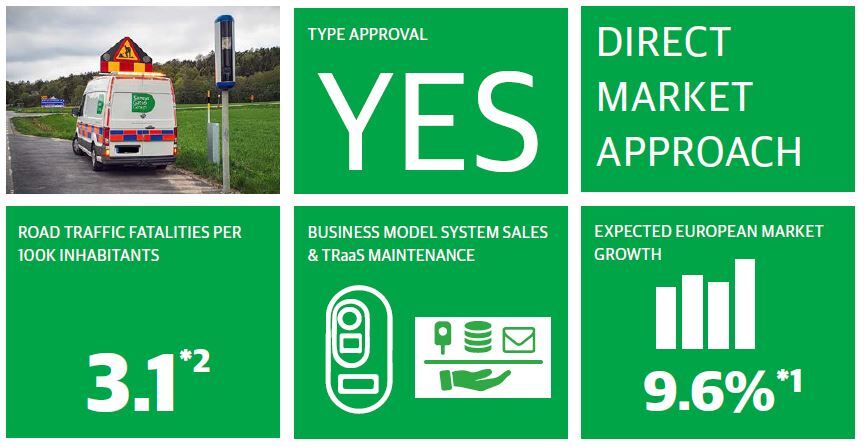
The Swedish government has been pursuing the Vision Zero philosophy to traffic safety since 1997. The main portion of the fatalities occurred on rural roads where the risk for head-to-head collisions was high and at junctions where the risk for side impact collisions were high. Therefore the Swedish Police and the Swedish Transport Administration decided to implement an extensive national speed enforcement program focusing on rural roads, as one of the major measures under the Vision Zero program.
One of the key elements of Vision Zero is Speed Enforcement. The overall goal of using traffic safety cameras is to lower the average speed on the roads and thereby reduce the number of crashes and fatalities or injuries. In order to achieve this goal, installation sites for cameras are chosen in areas where the average speed is high and where there is a significant danger of crashes. As one of the highlights of the program, the percentage of vehicles that were speeding on roads included in the program with a speed limit of 70 km/h dropped from 3.3% in 2020 to 2.8% 2021 which is a decrease of 15%.
In November 2022 Sensys Gatso Sweden won the big nation wide procurement award for traffic safety equipment and TRaaS services in Sweden. The estimated contract value over a 12-year period is worth up to SEK 850 million, and Sensys Gatso expects to deliver traffic safety equipment and TRaaS services for approximately SEK 400 million in the first 6 years.
The Swedish Transport Administration selected Sensys Gatso’s speed safety systems due to the proven legal integrity and high image quality which was proven in thorough competitive testing.
Finland
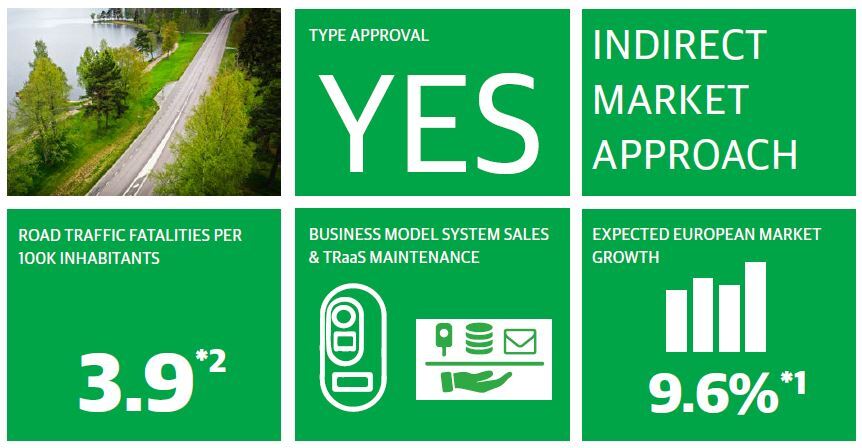
Automatic Traffic Control (ATK) is one of the most important tools for making Finnish roads safer. Today there are 1,085 fixed checkpoints covering more than 3,784 km of road. Fintraffic (Finnish Transport Infrastructure Agency) is responsible for the deployment of checkpoints, while the Finnish Police is responsible for the purchase of traffic cameras and the handling of traffic offenses and violations identified via ATK. The municipalities in Finland also have the right to build checkpoints to improve traffic safety in the area.
The plan for Fintraffic is to increase the number of control points in the near future, and during the winter 23/24, a new procurement was carried out by ATK. In that tender, the technology of Sensys Gatso was chosen for fixed control points. In Finland, Sensys Gatso works with a systems integrator, which provides the delivery, installation, and service of the equipment. They also take care of the services to provide the police and Fintraffic with a well-functioning network of ATK.
In 2023, 173 people died in traffic in Finland, a record low number that shows that the safety work is paying off. The goal is to reach under 100 deaths in traffic by the year 2030, according to the Finnish Road Safety Council.*5 Sensys Gatso looks forward to helping Fintraffic and the Finnish police achieve the goal by sharing the experience gained from global traffic safety work for more than 5 decades.
Sensys Gatso Netherlands
The Netherlands
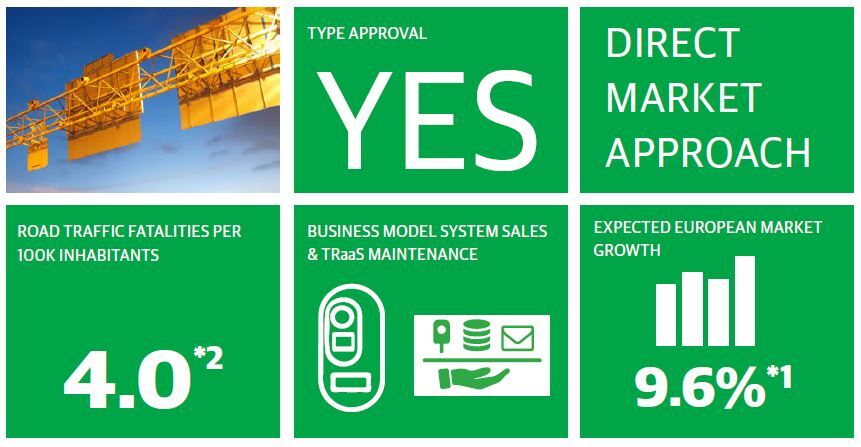
The speed enforcement system as we know it these days was invented by Maurice Gatsonides in the Netherlands. The Dutch authorities have, ever since the introduction of the speed enforcement system, made use of it. Over the years, procurement, operations and maintenance have been dealt with by both the police and the Ministry of Justice. In the 80’s and 90’s, it was a decentralized function, managed by local police forces. In the late 1990s, the automated traffic enforcement function became the responsibility of the centralized Dutch Prosecution Office.
In the Netherlands, automated traffic enforcement consists of speed enforcement, red-light enforcement and, as of late 2024 also enforcement on use of handheld devices in the car will be introduced. Automated speed enforcement is done with either spot speed (sometimes in combination with red- lights) or section control. The use of the latter has increased over the last decade, as it is thought of as a better way of enforcing laws as it carries a number of advantages.
The Dutch customer typically procures its automated traffic enforcement projects with 2 or more vendors. This is done in order to spread the risks when executing a project. Sensys Gatso currently serves the Dutch Prosecution Office with fixed Speed and Red-Light systems and section control systems both on the highways as well as the rural roads. With the Netherlands being one of the home markets of Sensys Gatso, this market is served directly by Sensys Gatso the Netherlands in Haarlem.
Switzerland
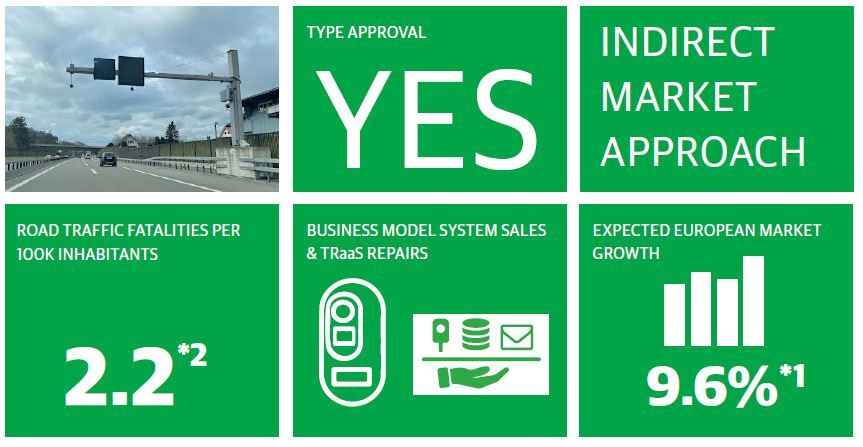
The Swiss market is characterized by a well-developed road network as well as a high degree of automated monitoring on both country roads and motorways. Road safety in the country is among the best in Europe, and the Swiss are generally more positive about automated traffic monitoring of speed than in the rest of the EU*3. Despite a safe traffic environment, 236 people have died in traffic in 2023 and the work to reduce deaths and serious injuries is carried out continuously at a central level with the goal that fewer than 100 deaths will occur in traffic by 2030*4.
Switzerland is a decentralized market where traffic monitoring of the highway network takes place through ASTRA, the federal roads office, while monitoring of country roads takes place through the local regions, the cantons.
All traffic enforcement equipment used must be type-approved. The legal requirements in Switzerland, with a vehicle owner’s responsibility for lower-speed offenses and a driver’s responsibility for more serious offenses, place high demands on the technical solutions that Sensys Gatso delivers. Switzerland is also a pioneer in variable-speed monitoring on motorways. Sensys Gatso has a large installed base in Switzerland and uses an indirect sales model in Switzerland.
Sensys Gatso Australia
Australia
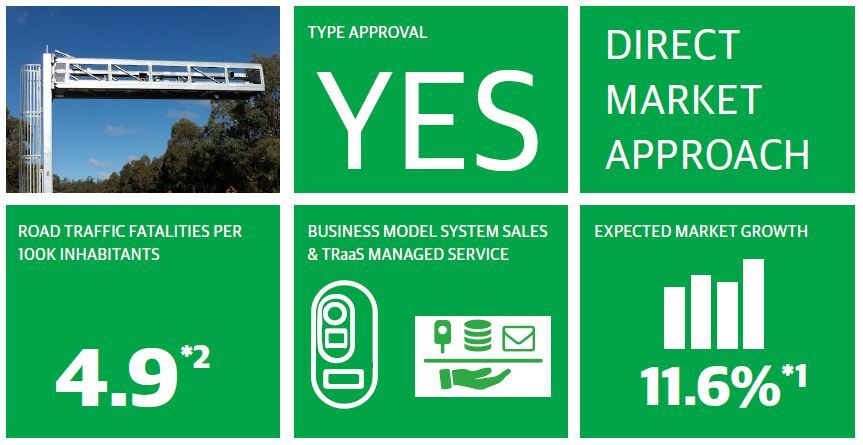
Sensys Gatso’s business in Australia services the 6th largest country in the world by geographic area. With a land mass approximately the size of mainland USA, the eight (8) States and Territories act as an independently governed jurisdiction. Each territory has its own technical, legal, and operational approval requirements. The growing population is over 26 million and unfortunately, in 2023, the number of lives lost on the road grew disproportionately, with an increase recorded in most jurisdictions.
The common goal we share with our clients is to reduce the number of lives lost and serious injuries on the road network. With one of the highest kilometres of road per capita in the world, this goal has seen the models for traffic safety and enforcement evolve over recent years. Our clients have become more open to a managed service approach, using service providers like Sensys Gatso Australia (SGA) to help them keep the road network safe.
Most recently, in conjunction with our client in Tasmania, the collaboratively managed service-based enforcement program helped reduce lives lost on the road by approximately 40% year to year. SGA established this TRaaS delivery model in late 2022 on a framework agreement that provides for various types of enforcement to choose from. Since inception, the model has increased the number of hours of speed enforcement, added Distracted Driver enforcement (a first for Sensy Gatso globally) and is currently transitioning into the added functionality of unregistered vehicle and mobile average speed enforcement services.
To address the unique jurisdictional requirements, which include secondary speed verification, the Sensys Gatso team in Australia has become skilled in the integration of technical solutions. With the trend of increased managed service delivery models and the aggregation of enforcement solution types, the SGA business is well placed to capitalise on the market opportunity.
Sensys Gatso Middle East
United Arab Emirates
The United Arab Emirates is known for its rapid development and economic diversification. The UAE has successfully diversified its economy from oil and gas to sectors like tourism, real estate, finance, and logistics. This diversification has contributed to its overall growth and resilience. The UAE is known for its impressive infrastructure, including world-class airports, seaports, roads, and telecommunications networks.
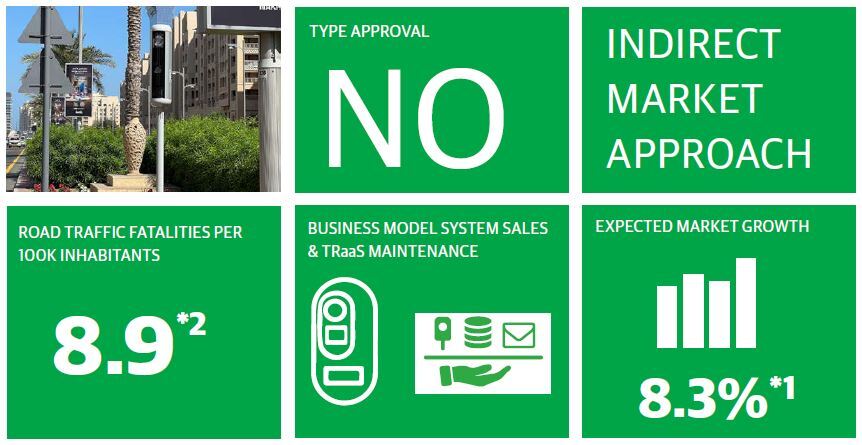
Sensys Gatso has several customers in the various Emirates. In the Emirate of Dubai, Sensys Gatso’s customer is the Dubai Police. With the focus on technology and innovation, Dubai Police is one of the world’s most innovative police forces. Since 2006, Dubai Police have been very effective in drastically reducing traffic related fatalities, despite the fact that population, road networks, bridges/ tunnels etc. in Dubai have more than doubled.
Dubai Police is currently using more than 800 roadside systems for speed and red-light enforcement which have (among other measures) heavily contributed to improved driving behavior and hence improved traffic safety. Dubai Police also has extensive backend operations related to data flow (processing and storing) from Traffic Law Enforcement systems as well as other sources such as CCTV cameras.
Global megatrends such as digitalization, automation and sustainability are expected to have profound effects on Dubai Police’s strategy and operation for Traffic Law Enforcement. Dubai Police recently signed a 5-year plan with SGG through its partner KTC over 500 enforcement systems from 2023-2027, expected value being between 500-1000 MSEK. These will both add to and replace some of the existing installed base in Dubai.
Saudi Arabia
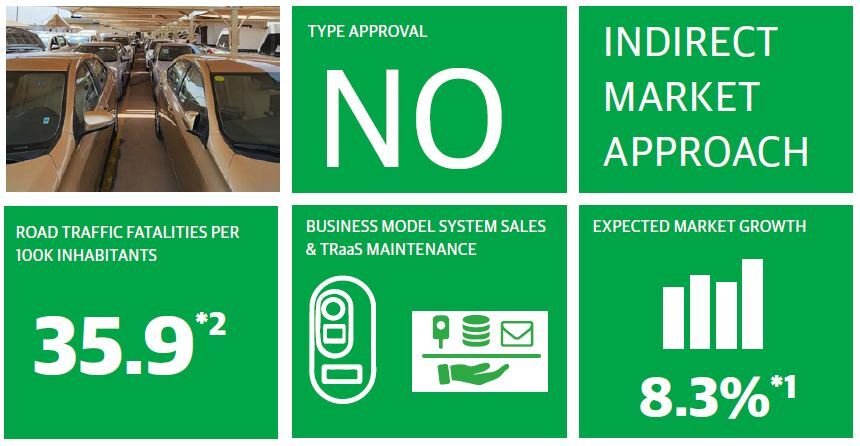
Saudi Arabia is known for having the largest economy in the region. Saudi Arabia possesses one of the world’s largest oil reserves and is a leading exporter of petroleum. The oil industry has historically been a significant driver of the country’s economy and government revenues.
Saudi Arabia has implemented an ambitious reform program called Vision 2030, aimed at diversifying the economy, reducing dependence on oil, and promoting sectors such as tourism, entertainment, technology, and renewable energy. In the Vision 2030 program, specific attention is given to sustainability and the increase of traffic safety, both of which are directly linked to the United Nations Sustainability Goals .
Sensys Gatso’s customer, the Saudi Technology and Security Comprehensive Control Company (Tahakom), was established in 2015 with inspiring ambition and a clear vision for achieving public safety and smart mobility. Since then, Tahakom has become one of the leading national companies contributing to developing local content through solutions in a bid to preserve human life and create economic value for the kingdom. Based on Saudi Vision 2030’s goal of “smart cities”, Tahakom offers strategic solutions to enhance the quality of life and ensure public safety.
The traffic law enforcement market in Saudi Arabia boasts an impressive annual value of USD 167M*1. Typically, Tahakom issues tenders based on 3-year plans, with each tender normally requesting a large number of systems in each category. These categories may include Fixed-Speed, Red-Light, and mobile tripod systems, among others.
Sources:
*1 MarketandMarkets, Road Safety Market, Global Forecast to 2026
*2 World Health Organisation, Global Health Observatory data repository, 2019 Road Traffic Fatalities
*3 European Road Safety Observatory National Road Safety Profile - Switzerland
*4 OECD Road Safety Report 2021 Switzerland
*5 YLE.FI, Traffic-related fatalities at record low in 2023